Last reviewed: November 2026. Your state or local food code applies. Follow the product supplier’s storage instructions where they are stricter.
Setting the right temperature protects food safety, quality and your energy bill. Here are the practical numbers.
The rules you must meet
- Cold holding: the FDA Food Code requires time/temperature control for safety (TCS) foods to be held at 41°F (5°C) or below.
- Frozen food: the Food Code requires frozen food to stay frozen (§3-501.11). 0°F (−18°C) or below is a common operating target for quality.
- Shell eggs: raw shell eggs may be held at an air temperature of 45°F or below (§3-501.16(B)).
Practical settings
| Box or product | Typical setting | Source and notes |
|---|---|---|
| General restaurant cooler | 35–38°F | Common commercial setpoint that leaves a margin under 41°F (The Restaurant Warehouse); one manufacturer FAQ suggests 35°F |
| Fresh meat | 28–32°F chill-room range for beef | GCCA storage manual and Cargill’s boxed beef guidance; colder storage extends shelf life, but avoid freezing fresh product |
| Poultry | 32–40°F chilled | GCCA storage manual |
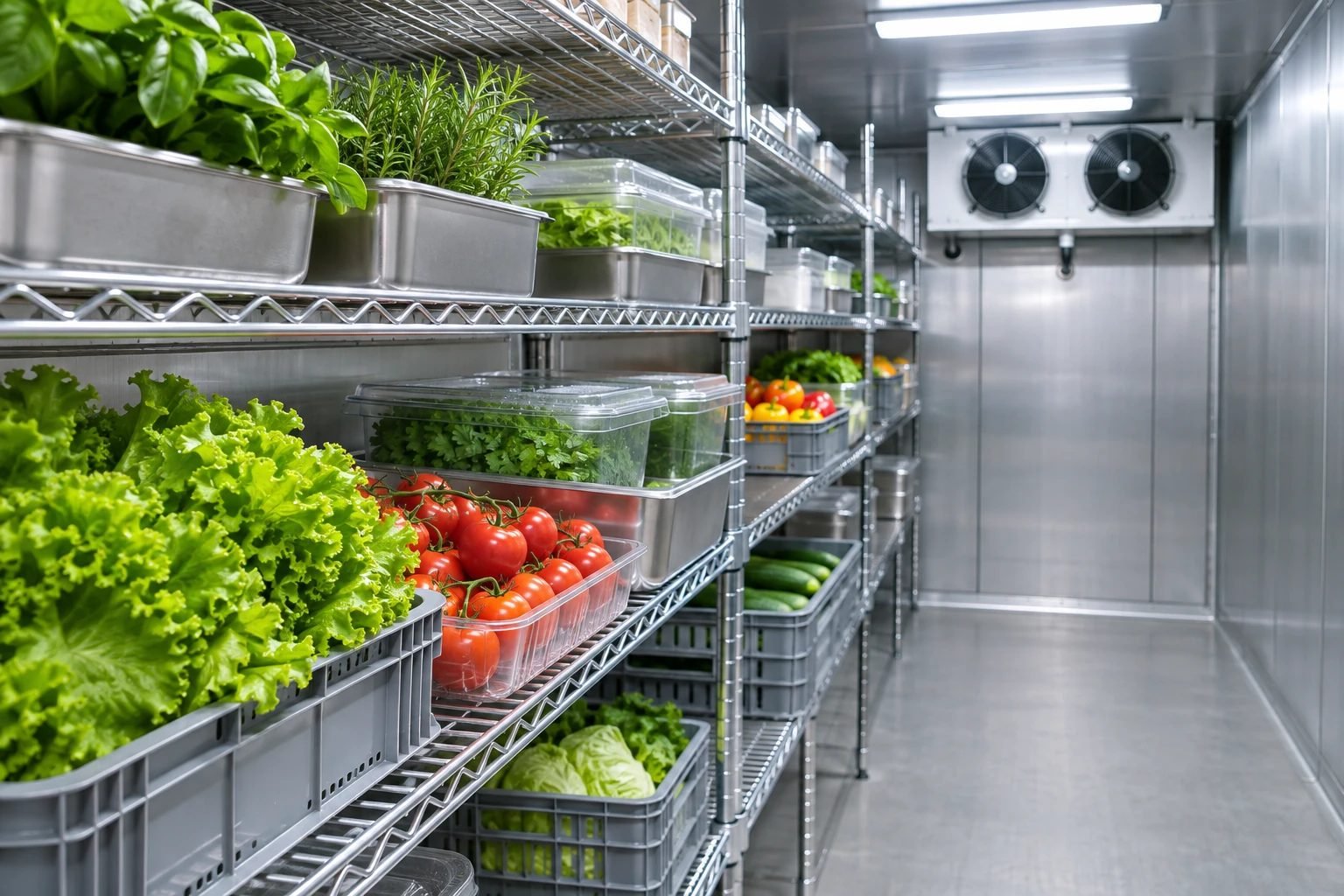
| Leafy greens, broccoli, carrots and similar produce | 32–36°F, high humidity | USDA Handbook 66 data via Utah State Extension; some produce is chill-sensitive, see below |
| Keg beer | 34–38°F | Brewers Association; 38°F is the standard dispense temperature |
| Cut flowers | 33–35°F | NC State; tropical flowers need 50–55°F. See Florists |
| Walk-in freezer | 0°F or below, often about −10°F | USDA FSIS (0°F); FE&S FAQ (−10°F). Ice cream is often stored at −10 to −20°F (KaTom) |
Produce that dislikes the cold
Bananas, tomatoes, potatoes, onions, winter squash, basil and many tropical fruits can suffer chill injury in a typical walk-in. Store them in a cool dry room instead, or follow your supplier’s advice. See Walk-Ins for Grocery and Produce.
Air temperature vs product temperature
- The display shows air temperature, which swings with door openings and defrost.
- Inspectors care about product temperature. Check it with a probe thermometer.
- Place a thermometer in the warmest part of the box, usually near the door, as required by many codes.
Why not just set it colder?
- Produce and some products can freeze near the evaporator.
- Each degree colder uses more energy.
- The coil may ice up more often.
If the temperature drifts
See Walk-In Cooler Not Cooling? and set up temperature alarms.
Sources
- FDA Food Code 2026 (check the edition your state has adopted)
- USDA FSIS: Freezing and Food Safety
- The Restaurant Warehouse: Correct walk-in cooler temperature
- FE&S: Walk-in cooler and freezer FAQs (35°F coolers, −10°F freezers)
- GCCA/WFLO Commodity Storage Manual: Meats, chilled and frozen
- Cargill: Boxed beef storage chart
- Utah State Extension: Postharvest handling (USDA Handbook 66 data)
- Brewers Association: Draught Beer Quality Manual for Retailers (PDF)
- NC State: Cut flower storage temperature research
- KaTom: Freezer temperature for storing ice cream
- University of Maine Extension: Storage conditions for fruits and vegetables
- FDA: Food Code adoption by states